Showing posts with label Destinations. Show all posts

Friday, March 4, 2011

Songkran Festival April 13 - 15, 2011

AS mid-April's temperature rises, ushering in the beginning of the hot season in Thailand, the whole country reverberates with the sounds of cheerful laughter and merry-making. The occasion is the Songkran festival, which ushers in the Thai New Year, celebrated nation­wide from April 13-15 yearly. It is a time when much of the worries of the past year are left behind so that a new beginning could be planned for the year ahead.
The water-splashing that usually accompanies a Thai New Year is certainly most appropriate, especially during the hot month.

Step out of your hotel rooms and you would probably be greeted by young and old alike with buckets of water or water guns, especially desig­ned for the occasion. And if you are lucky, then the splashing would be followed by a face make­up with talcum powder and perfume. `Songkran' (from the Sanskrit word Sankranti, signifying the sun's shift from one zodiac to ano­ther) heralding the beginning of the solar year and is the most important festival for the people of Thailand.

The festival is celebrated over three days, Ma­hasongkran on April 13, that marks the end of the old year, Wan Nao (April 14) is the day after and April 15 is Wan Thaloeng Sok when the New Year begins.

On New Year's Day, families and friends ga­ther to offer prayers to the Buddha, clean tem­ples and houses, offer alms to the monks and sprinkle scented water on elders as a mark of res­pect and on each other's hands as an act of wish­ing good luck.

The pouring of water is symbolic of the clean­sing of the spirit, mind and body. The water is also supposed to wash away bad luck-so consi­der yourself blessed if you get drenched.

In recent years, the tradition of sprinkling wa­ter has been interpreted by youngsters as a great excuse for a water fight, and it is not uncommon to have buckets and containers of water thrown at you by teams of merry makers in the backs of trucks as you make your way down the street - particularly in major tourist areas like Bangkok, Phuket, Pattaya, Chiang Mai and Hat Yai.

The people of Thailand work hard in a very hot climate, so it only makes sense that their big­gest party is the world's largest water fight ac­companied with music, dancing and tons of splashing, as the typically mellow populace ex­plodes into wild celebration.

M. Hat Yai, there is something called the Mid­night Songkran, where festivities and splashing of water begin at the stroke of midnight on April 12 to cater to the large number of tourists from Malaysia who trooped to the southern Thai city to join in the fun.

This year, the Thai New Year falls on a Wed­nesday. Make sure you book your accommoda­tion early as you don't want to miss out on this yearly celebration.

Information extracted from Thailand Travel Talk (March Edition) for further information visit http://www.tourismthailand.org/

Saturday, February 27, 2010

Haridwar during Kumbh Mela


Read about the mistique of the sacred Haridwar written by Anirban Das Mahapatra. Extracted from The Personal Telegraph Calcutta.

Click here to read

Monday, May 18, 2009

Andaman & Nicobar Islands


ABOUT ANDAMAN

District of Andaman is Northern Part of Andaman & Nicobar Islands and comprises of 550 Islands, Islets and rocks out of which only 26 are inhabited. Some of these islands are large such as Middle Andaman, North Andaman, South Andaman, Baratang and Little Andaman islands. The northern most islands is Landfall and southern most Little Andaman. The total area of Andaman District is 6,408 Sq.Kms. The highest point of the territory is also situated in this District at Diglipur. There are four primitive tribes in Andaman District and they have been recognized as belonging to the Negrito stock, namely Great Andamanese, Onges, Jarawas and Sentinelese. Floating in splendid isolation, east of the Indian mainland is the archipelago of 572 emerald islands, islets and rocks known as Andaman and Nicobar Islands. This Union Territory is stretched over an area of more than 800 kms. From north to south with 36 inhabited islands. Once a hill range extending from Burma (Myanmar) to exotic flowers and birds. The topography of the islands is hilly and abounds in evergreen forests. The sandy beaches on the edge of meandering coastline are fringed with coconut-palms that sway to the rhythm of the sea. The sea around the islands offers excellent scope for water sports. The rare flora and fauna, underwater marine life and corals, with crystal clear water and mangrove-lined creeks, offer a dream-view of the rare gifts of nature. The clean and wide roads, free of filth as well as unpolluted fresh air attract any nature-lover, who seek absolute peace and tranquility in the lap of mother nature. Adventure tourism like trekking, island camping, snorkeling, scuba diving etc., are the real attractions. A visit to these islands is a memorable lifetime experience. Mythologically, the name Andaman was presumed to be derived from Hanuman, who was known to the Malays as Handuman. Since pre-historic times, these islands were the home of aboriginal tribes. The tribes of the Andaman group of islands are the Great Andamanese, Onges, Jarawas, and Sentinalese, all of Negrito origin, while the tribes of Nicobars are the Nicobarese and Shompens, both of Mongoloid stock. The first settlement by the British took place in 1789, which was later abandoned in 1796. The second settlement was basically a penal settlement, taken up in 1858, after the First War of Independence, followed by the settlement of convicts, Moplas, some criminal tribes from Central and United Provinces, refugees from erstwhile East Pakistan, Burma and Sri Lanka as well as ex-servicemen. In these islands people of all faiths-Hindus, Muslims, Christians, Sikhs etc., and of all languages like Hindi, Bengali, Tamil, Telugu, Punjabi, Nicobari etc., live together in complete peace and harmony. Inter-religion and inter-regional marriages are common. This amazing racial and cultural mix is correctly described as Mini-India. Forests are the green gold of the islands. The reserved and protected forests extend over 86% area of the territory and the forest cover is more than 92% About 50% of the forests has been set aside as Tribal Reserves, National Parks and Wildlife Sanctuaries, which are inviolate. Luxuriant mangroves, perhaps one of the riches in the world, occupy nearly 11.5% of the territory. More than 150 plant and animal species are endemic in nature. Mahatma Gandhi Marine National Park is rich in corals, varieties of coloured fishes, sea turtles etc., besides other marine life. It is a bird's paradise - more than 271 varieties of birds inhabit the idyllic landscape, out of which 39 are endemic. Megapode, Swiflet, Hornbill and Nicobar, Pigeon are some of the specialties of the Andaman and Nicobar Islands.

For further information please visit http://tourism.andaman.nic.in/

Monday, March 2, 2009

China's Little Venice

Not far from Shanghai, Zhujiajiao is an ancient town located on the banks of the Dianshan Lake in Qingpu district. It is said to be 1700 years old and is one of the best preserved ancient towns of China. It’s waterways and boats give it a special charm. Hence the name little Venice suits it well.
Just like Venice this charming and peaceful town lends itself to walking. Wander its narrow lanes, browse around its many shops as you are transported track in time. Samll bridges over gurgling waterways, Ming and Qing style homes, weeping willows swaying along the river banks the scene is idyllic and gives you a sense of deja. Cross the famous Fangsheng Bridge dating back the Ming Dynasty, as it offers great views.
You have to buy a ticket to even walk around and see the little town. A more expensive ticket entitles you to not only walk around but free entry to “10 scenic spots” (the Fangsheng or Rainbow Bridge being one) as well as a complimentary rickshaw ride.
Now for the 10 scenic spots. The Fishermen’s Home is a museum of fishing tools and related fisher folks culture. Zhujiajiao was once a thriving fishing village so you get to imagine what life was like in days gone by. The Ancestor pottery and jade hall, has, as the name suggests, a large collection of jade and pottery. Jade has always been considered lucky. A Chinese Pharmacy is also on the list. Traditional Chinese medicine is practiced even today and provides a holistic cure in much the same way as Ayurveda. The City God temple has a 1000 years old ginkgo tree and 2 other treasures, a stage and an abacus. How the tree has survived 1000 years a mystery.
The Kezhigarden was built in the early 20th century and has 2 gardens the Ke (study) and Zhi (farming). The Silk Road Museum, the Post Office and the Hall of Paddy and Rice Customs tell their own tale. The Silk Road Museum is interesting especially if you are a history buff.
You definitely imagine you are in a village 1700 years old, as you walk around taking in the sights. The small houses, narrow lanes and the criss – crossing rivulets do not seem to have changed much since they were first built. About 30 odd bridges, span the waterways and have a charm all their own. The old houses which have white walls and grey tiles face the streets and have their backs to the water. People live upstairs with the ground floor used for cooking. If you are hungry and walking along, the aroma of food cooking in their kitchen sends you scurrying for a place to eat. You don’t have far to go as small eateries are everywhere. If you just want a snack, try the vendors selling rice dumplings stuffed with meat, they are finger-licking delicious.
After a snack or a meal you can shop around the hundreds of small shops selling handicrafts and souvenirs. There is a lot to buy and you won’t be disappointed. After shopping you can return to Shanghai well fed, though a little tired with all the walking.


For more information contact China National Tourism Administration, 9A Jianguomennei Ave., Beijing 100740, China, Tel: +86-10-65201114, Fax: +86-10-65122096, Email:
webmaster@cnta.gov.cn and website: www.cnta.gov.cn

Saturday, February 21, 2009

Phang-Nga, The Island of Sacramanga

Situated as it is by the Andaman Sea Phang-Nga’s scenic views of forests and islands, green waters, blue skies and rugged cliffs attract Nature lovers who are mesmerized by its beauty. It has many national parks, the most famous being Phang-Nga National Park. This is a geological wonder with islets, sunken, caverns and exotic rock formations rising sheer out of the sea: The Bay being sheltered is ideal for sea canoe exploring. Hat Khao Lak near Phang-Nga district has a beautiful long beach along the Andaman Sea. The green mountains of Khao Lak – Lumru National Park, parallel to the coast, are full of birds, mammals and scenic waterfalls. This was where the December 2004 Tsunami wreaked havoc though many hotels have come up again. Phang-Nga’s main landmark is a large hill looking like a kneeling elephant. The town’s beautiful old building is the Provincial Hall. The Phung-Chang Cave is behind the City Hall. You will see beautiful stalagmites and stalactites in this cave Khao-Ngum Cave lies across from its entrance. Here too you see stalactites and stalagmites.


Phuket is a take off point for Phang Nga Bay Cruises with a trip to the “James Bond Island” or the island of Scaramanga in the film “The Man with the Golden Gun”. This is an eco tour like no other. As you sail into the waters of the Andaman Sea, spectacular scenery unfolds before your eyes. Green water with massive limestone rocks streaked with red and green greet you while pristine beaches and virgin islands add to the beauty. Phang Nga Bay is sheltered from the northeast and southwest Monsoons and hence has calm waters year round making it a sailor’s paradise.


The fishing village of Koh Pan Yee built on concrete stilts over the sea sits guarded by a gigantic rock, another James Bond movie landmark, as the guide tells you. Explore the village or perhaps pick up a souvenir from the hundreds of tiny shops which exist only for tourists. Sailing to the Kaho Hong at Phang Nga National Park is a mystical experience A “hong” is a hollowed out island or collapsed cave, open to the sky so as you enter the Kaho Hong by boat (provided the tide is right) you feel as though you are entering a big reception hall with towering limestone walls. Sea canoeing is a major eco-tourism activity as you can go around hundreds of limestone islands dotting the Andaman sea. A rafting trip from Phuket includes sightseeing at the Phang-Nga Wildlife Park, elephant rides and rafting in the Parivat wildlife conservation area.


On Khao Lan Hill in Tambon Bang Riang is the temple- “Wat Bang Riang” with an elaborate bell shaped pagoda, Chedi Putthathambanlue, overlooking a huge Buddha image and one of Guan-yin, a Chinese goddess. An interesting thing to buy in Phang-Nga town is artificial flowers made by village women out of rubber tree leaves. The town is also famous for shrimp paste (kapi) and dried shrimp. So enjoy Thai food while you visit and shop for shrimp delights to take back home.


For more information Tourism Authority of Thailand, 1600 New Phetchaburi Road, Makkasan, Ratchathewi , Bangkok 10400, Thailand, Tel:+66-022505500, Fax:+66-022505511, email: center@tat.or.th and website: http://www.tourismthailand.org

Tuesday, February 17, 2009

BATTAMBANG, CITY OF TEMPLES


Battambang, Cambodia’s second largest city founded in the 11th century, has maintained its local atmosphere, and charm. “Bat Dambang” literally means “lost staff”. Legend has it that King Kron Nhong threw his wooden staff from Angkor (of Angkok Wat Temples fame) and it landed where present day Battambang stands. The legend is commemorated by a huge golden statue in honour of King Kron Nhong in the town.


Battambang is a spacious town on the Sangkor river. The town has a very French colonial look due to French rule. Little has changed since the 1950s when the French colonial era ended. So relax and enjoy looking around as the pace is slow and laid back. Watch the sunset along the banks of the river and take in the cool breeze.


The town is surrounded by lush green rice paddies which provide enough to feed the whole country. The local oranges are very sweet, so enjoy them if they are in season. They are great thirst quenchers. The area is know for its rubies and garnets. If you intended to shop for these the best place to do so is in Poipet. The rubies pale by comparison to the Burmese “pigeon blood red”, rubies but are of quite good quality, as are the garnets.


Around Battambang you can see a number of Angkor era temples many of which date from the 10th to the 15th centuries. If you like temples then you will enjoy visiting them. The 11th century temple of Ek Phnom, the temple grottoes and the Buddhist shrines of Wat Sampacu are all marvels of the craftsman’s art. The locals are friendly and helpful in case you get lost.
The 11th century mountain temples of Phnom Banan are one of the towns most famous historical attractions. So put on your walking shoes, carry a bottle of water and head for the temples. For those fond of nature Kamping Puoj is the place to go. Remember to pack a picnic lunch, relax and enjoy a peaceful break. You will feel energized once again.


Along the riverbank you will find some of the best examples of French colonial architecture which seems a bit incongruous keeping the local ambience in mind. Battambang has a small Museum on the river north of the post office. This has some beautiful statues of Buddha both in stone and wood.


Being close to Thailand, at one time both Battambang and Siem Reap (of Angkor Wat fame) were under Thailand’s control and the Thai influence is quite evident still specially in the food. So Battambang is an interesting medly of Thai, French and Angkor styles in architecture, culture and food.


Battambang less famous than Siem Reap but has some lovely temples and a quiet charm. So you can visit the temples of the Angkor era at leisure before hordes start descending on it and shattering the peace of this gentle charming town.


For more information contact Ministry of Tourism, #3 Monivong Blvd., Phnom Penh 12258, Cambodia.Tel:+855-23- 212837, 213911, Fax:+855-23 216875/ 426364, Email: info@mot.gov.kh and website:http://www.mot.gov.kh

Thursday, October 30, 2008

Oh...Trichy...trichy...trichy!!!!

Rockfort

Trichy or Tiruchirappalli, situated on the banks of the river Cauvery is the fourth largest city in Tamil Nadu. It was a citadel of the early Cholas which later fell to the Pallavas. Trichy is a fine blend of tradition and modernity built around the Rock Fort. Apart from the Fort, there are several Churches, Colleges and Missions dating back to the 1760s. The town and its fort, now in Trichy were built by the Nayaks of Madurai.

The most famous land mark of this bustling town is the Rockfort Temple, a spectacular monument perched on a massive rocky out crop which rises abruptly from the plain to tower over the old city. It was one of the main centers around which the wars of the Carnatic were fought in the 18th century during the British-French struggle for supremacy in India. The city is a thriving commercial centre in Tamil Nadu and is famous for artificial diamonds, cigars, handloom cloth, glass bangles and wooden and clay toys.

As of today Air Asia will be flying direct to Trichy offering flights at an astonishingly affordable rate. So we Anand Travels have made certain facilities available for our customers such as:
  • Transportation facilities
  • Tailor made tour packages
  • Our very own office Rockfort Traveltours Pvt.Ltd ,Suite 5 ,3rd floor,Tabs Complex,Bharathidasn Salai,Cantonement, Trichy at your service for all services (eg: train,bus tickets,air ticket reschedulling, etc) .
  • Optional ReadyMade City tour packages


Thursday, September 25, 2008

HIDDEN TREASURES OF CHINA

DESTINATION OF THE WEEK
CHINA’S CHENGDE – A FORESTED MOUNTAIN RESORT

Chengde lies in a valley in northern Hebei Province about 163 km/100 miles from Beijing It is known in China as “Mountain Hamlet for Escaping the Heat” (Bishu Shanzhuang) as it was the hill resort of the former Imperial family. The area of the resort is about twice as big as Beijing’s Summer Palace. Emperor Kangxi (1662-1772) who belonged to the Qing dynasty had the resort built to escape the heat and he came here every summer. Here he and emperors after him would relax away from the heat. They would hold feasts for Mongolian nobles and chiefs from neighbouring Xinjiang and Tibet. Hunting and archery on horseback were favorite sports to while the time away. Even today Chengde attracts visitors for its pleasant climate.
This resort, a UNESCO World Heritage Site has lakes, hills and plains, though the hills make up almost four fifths of the resort. They are covered with forests of pine and cypresses. If you go up to the snow Pavilion of South Hill (Nanshan Jixue Ting) you get a commanding view of the whole resort, lush and green and dotted with blue lakes. When the wind blows the sound of whispering pines is music to the ears.
There are only five lakes divided and separated by embankments. There are a number of small islands connected by quaint bridges. All the structures in the lake area borrow their architectural styles from neighboring areas. The tower of Mist and Rain (Yanyu Lou) is an exact replica of a similar structure at Nanlu Lake. Similarly the golden Hill Pavilion is like its namesake in Zenjiang. What is truly beautiful to behold are the temples that dot the hills to the north and east of the resort. They were built in the 18th century. They are built in what has come to be known in China as the Han, Mongolian and Tibetan styles.
Along with the resort these temples constitute one of the three major ancient architectural groups in China the other two being the Imperial Palace in Beijing and the Confucius Mansion etc in Qufu.
Of the Temples the most attractive is the Temple of Universal Tranquility (Puning Si). It is a Buddhist temple with the Mahayana Hall housing a carved wooden Buddha. This Buddha is about 25 meters high. It is said to be the biggest carved wooden Buddha in China. From outside, the temple is a bit deceptive as it looks as though it is made up on five-storeys.
There is another interesting temple built in the Tibetan style and patterned after the Potala Palace of the Dalai Lama in Lhasa. Perhaps this is why it is called the Little Potala. It is not so little though as it is the biggest of the eight temples. Its roof is adorned with gilded copper tiles. Guides will tell you that gold has gone into the gilding of each tile. Another temple built in the Tibetan style is the Temple of Sumeru Happiness and Longevity. This also has gilded tiles.
Chengde is cool and peaceful and makes for a lovely summer break. So enjoy the cool weather and your visit to the temples, reminders of China’s Imperial past.


For more information contact China National Tourism Administration, 9A Jianguomennei Ave., Beijing 100740, China, Tel: +86-10-65201114, Fax: +86-10-65122096, Email: webmaster@cnta.gov.cn and website: www.cnta.gov.cn

Monday, August 4, 2008

Hiroshima

JAPAN’S HIROSHIMA: THE CITY THAT ROSE FROM ASHES


Hiroshima Now a Modern Metropolis

Sixth August 1945 is etched in many minds, the date when Honshu’s largest city witnessed the devastating and horrific effects of the atom bomb. Today millions visit it to pay their respects. Hiroshima on the western end of the Inland Sea has been re-born as a vibrant, bigger and brighter city and is eloquent testimony to a “never say die” spirit of it’s people. The phoenix has risen from the ashes.


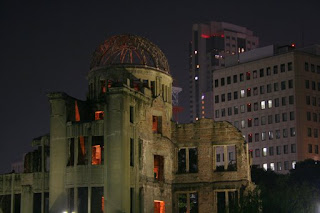
Take the street car to the A-Bomb Dome, a symbol of the destruction wreaked upon Hiroshima, a UNESCO world heritage site. The main structure with the dome has survived. At night the dome is lit up as a constant reminder of the horrific attack.


Nakajima, an earlier urban district was converted into the Peace Memorial Park in 1949. It is dotted with a number of memorials A spherical clock faces three directions and is perched on a 20 meter high twisted tower of iron pillars. At 8.15 a.m. (the time the bomb fell) every day the clock chimes “No more Hiroshimas”.

The eternal Flame was lit on 1 August 1964 and will continue to burn till, “the last nuclear weapon is destroyed from the world”. Just a little behind the Eternal Flame you see the Cenotaph, shaped like an arch with a stone chest in the centre. The arch bears the inscription “Let all the souls here rest in peace, for we shall not repeat the evil”. The stone chest contains the names of all those who died because of the bombing. The Peace Memorial Museum is 2 huge buildings connected by a walkway. The East wing has displays on the after-effects of the atomic bomb, models of Hiroshima before and after, pictures, letters etc, even the letter that ordered the bombing. One display that speaks volumes is a wrist watch that stopped ticking at 8.15 a.m. The west wing has displays of a model of the bomb, the mushroom shaped cloud, burnt clothes, walls with glass splinters, bottles and boxes, twisted and melted, fused tiles-all poignant reminders of a horrible event. Large TVs screen films on the bombing and it’s aftermath. The corridor that leads to the exit is where you see a register of the names and photos of the victims. This Peace Memorial Museum wants to drive home the message of the horrors of the Bomb, “lest we forget”.


There is a positive side to Hiroshima as well. This is the power of life over destruction or nature’s way of renewing itself.


The children’s Peace Monument was inspired by Sadako, a 12 year old girl who died of leukemia, an after effect of the bomb. She started folding origami paper cranes hoping to get well. Paper cranes have since become a symbol of peace here and you will see countless colourful paper cranes scattered throughout the park.


Of course the visit does not do too much for your appetite. Even so Hiroshima is famous for its sea food. It is also the “jumping off” point for several islands the most famous being Miya-Jima (pic on left). This is where the famous Itsukushima Jinja is located. The view of its red “Tori” (gate) standing in the misty shallows in front of the shrine is one of Japans most celebrated icon.


For more information contact Japan National Tourism Organization, 10th Floor., Tokyo Kotsu Kaikan Bldg., 2-10-1, Yurakucho, Chiyoda-ku, Tokyo 100-0006, Tel: +80-3-3201-3331, Fax: +80-3-3201-3347, website: http://www.jnto.go.jp